There is an organization within Social Security called the Quality Review Board, also known internally as the Disability Quality Branch (DQB). The DQB samples initial and reconsideration determinations from state DDS agencies to ensure that Social Security’s disability rules and regulations are being interpreted and implemented properly by the various state DDS agencies – a
Gordon Gates
Gordon Gates specializes in Social Security disability law, and he handles claims at every level of the Social Security disability claim process. He assists clients with initial applications for disability benefits, with appeals of denied claims, and with hearings by an administrative law judge.
Gordon has successfully appealed unfavorable administrative law judge decisions the Social Security Appeals Council and to U.S. District Court (District of Maine) to have those claims remanded for new hearings.
Gordon attended Maine Maritime Academy and Tulane University Law School. At Tulane, he served as Senior Articles Editor of the Tulane Law Review and graduated magna cum laude. He was admitted to practice law in Maine in 1991. Since 2005, he has concentrated his law practice on Social Security disability and SSI cases.
Gordon is the publisher of Social Security Disability Lawyer, a nationally-read legal blog. He presented at the Fall 2010 conference of National Organization of Social Security Claimants' Representatives (NOSSCR) on the topic of Writing Hearing Briefs for the ALJ.
Past Relevant Work as Generally Performed
At Step 4 of Social Security’s sequential evaluation, the SSA considers the claimant’s ability to perform their past relevant work, both as actually performed and as generally performed in the national economy. That means that Social Security will evaluate your ability to do the jobs you have had over the past 15 years, both as described in your work history report and as generally performed.
If the job you had as a cashier was more demanding physically than that job is generally, and you could perform the job as generally performed, you will not be awarded disability benefits. On the face of it, this is a fair rule. But in practice, problems arise.
The first problem is that, to determine how a particular job is generally performed, Social Security refers to the Dictionary of Occupational Titles (DOT), a Department of Labor publication that hasn’t been updated since 1991 (and many jobs in the DOT date back to the 1970’s). So the description of a job’s requirements may be woefully outdated. I had this issue at a hearing recently, where an office-type job description in the DOT dated back to before there were PCs in the office, and before the internet. The job today is all about working on a computer and keyboarding, in a way the job wasn’t performed 30+ years ago. It took a lot of cajoling to get the vocational expert at the hearing to acknowledge that the job had evolved over time from its DOT description, and now required extensive use of the hands (which was a problem for my 63-year old client with severe psoriatic arthritis).
The disparity between the reality in the workplace and the dated job desciptions in DOT continues to grow with time. The issue has started to garner some media attention because of its unfairness. Claims are being denied using outdated vocational information.
Another problem is that a disability examiner at DDS may select a job title in the Dictionary of Occupational TItles that has the same name as the job performed by the claimant, but is a actually a different job.Continue Reading Past Relevant Work as Generally Performed
If you are still working, you are not eligible for Social Security disability benefits
I frequently talk with prospective clients who are thinking about applying for Social Security disability but are still working (and earning more than the 2023 SGA amount of $1,470 per month, gross pay).
These prospective clients sometimes want to discuss the likelihood of success for a disability claim, should they stop working and apply for…
New Hearing Format Form from NOSSCR
NOSSCR has developed what it calls a “Hearing Format Election Statement,” which is an excellent one-page, fillable form that contains all four types of hearing modalities (in-person, VTC, telephone, and online video) and allows for a simple way to notify the hearing office of how the claimant wants to appear at their hearing.
Using NOSSCR’s…
2022 “Waterfall” Chart
- 38% were allowed after an initial review of the application. That’s a bit more than last year.
- Just 15% of the claims appealed were allowed at Reconsideration. So 5
Hearing on long-haul COVID case
I had a hearing for a client who has been unable to work due to the symptoms of long-haul COVID, sometimes also referred to a postviral fatigue syndrome (PVFS).
My main challenge as a Representative has been to make sure Social Security recognizes that long-haul COVID cases are not like other cases. An appropriate RFC…
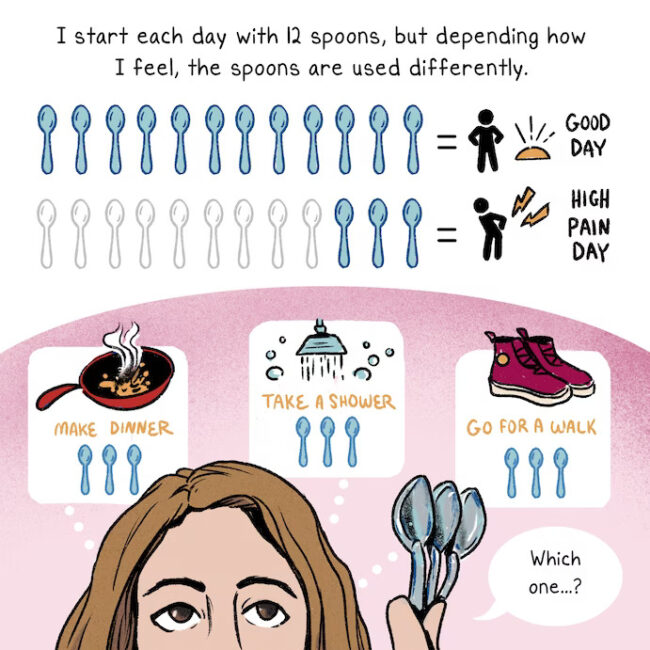
Chronic illness and limited daily energy

There is a great explainer in the Washington Post called Spoon theory: What it is and how I use it to manage chronic illness. The article, written by journalist Fortesa Latifi and illustrated by Lara Antal, has terrific graphic novel-style illustrations, including the one shown above. It conveys how those suffering with chronic…
Social Security’s Grid Rules
As dedicated readers know, at Step 5 of the disability sequential evaluation, Social Security uses the Medical-Vocational Guidliness to determine disability. The guidelines, or “grids,” direct a finding of “disabled” or “not disabled” based upon a person’s age, physical RFC, education and past work/transferable skills.
If the medical-vocational guidlines direct a result of “disabled,”…
Social Security uses outdated jobs data to evaluate disability claims
The Washington Post has an excellent article this week by reporter Lisa Rein, entitled “Social Security denies disability benefits based on list with jobs from 1977.” You should read the article in its entirety.
The Dictionary of Occupational Titles (DOT), published by the U.S. Department of Labor, is used by Social Security as…
Social Security has redesigned it website
Social Security has comprehensibly redesigned its website.
Some of the changes are discussed in a post on the Social Security blog.
I noticed that SSA revamped the online appeal page, making it much easier to understand and use.